What is beta-alanine and why does it stand out among sports supplements?
Although there are hundreds of nutritional supplements that claim to improve sports performance, only a few are supported by solid scientific evidence. Among them are protein, creatine, caffeine and, although less well known, beta-alanine.
Beta-alanine has traditionally been recognised for its benefits on high-intensity exercise performance, but more recent scientific evidence suggests that its effects may also be relevant in endurance sports.
Why can beta-alanine be relevant in endurance sports?
Although endurance sports are usually associated with prolonged and steady efforts, the competitive reality shows that performance is often decided by changes of pace, attacks or final sprints.
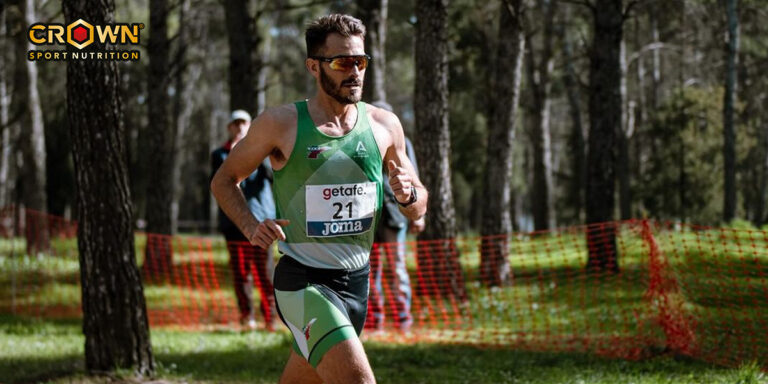
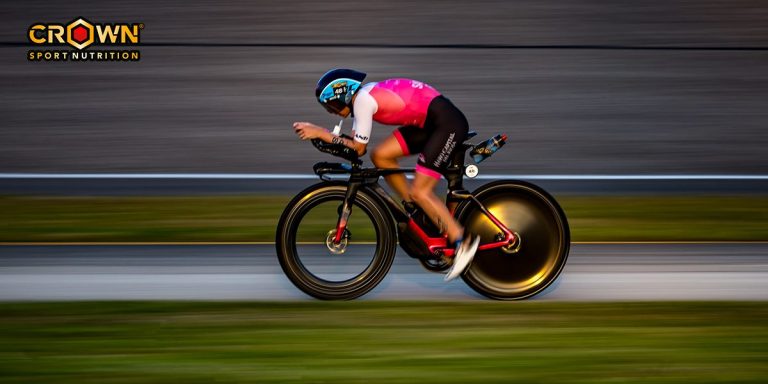
In disciplines such as cycling, the ability to respond to high-intensity efforts is key to staying in a breakaway or contesting the final of a race. Something similar occurs in trail running, where it is increasingly common for top positions to be decided in brief moments of very high intensity.
What scientific evidence supports beta-alanine supplementation?
A meta-analysis published in the British Journal of Sports Medicine, which analysed a total of 40 studies, showed that beta-alanine supplementation significantly improves sports performance, especially in exercises lasting between 1 and 10 minutes (1).
This time frame includes efforts characteristic not only of high-intensity sports, but also of key moments within endurance competitions.
How does beta-alanine work in the body?
The benefits of beta-alanine are due to its ability to increase muscle carnosine levels. Carnosine acts as a physiological buffer, helping to counteract the acidity produced during high-intensity exercise.
During this type of effort, what is known as metabolic acidosis occurs, caused by the accumulation of metabolites such as hydrogen ions, which interferes with muscle contraction and relaxation processes.
By increasing muscle carnosine, beta-alanine helps maintain muscle pH, improving the body’s ability to tolerate intense efforts (2).
What do studies in cyclists show about beta-alanine?
Although more evidence is still needed, there are already numerous studies showing that beta-alanine is beneficial for cyclists. More than 15 years ago, a study led by researcher Peter Hespel evaluated the effect of beta-alanine supplementation (2–4 g/day for 8 weeks) in a situation simulating a real race: a 10-minute time trial followed by a 30-second final sprint, performed after a simulated 110 km race (3).
The results showed that although average power during the time trial was similar in both groups (~300 W), peak sprint power increased by 11% (from 993 to 1105 W) and mean sprint power increased by 5% (from 693 to 727 W) in the beta-alanine group.
More recent studies in World Tour cyclists also confirm these benefits. Spanish researchers have recently analysed the effects of a high beta-alanine loading protocol over one week in professional cyclists. In the first study, cyclists consumed 20 g/day of beta-alanine (4 doses of 5 g) for 7 days and performed a 10-minute time trial.
Beta-alanine supplementation was associated with a 6.2% higher power output compared to placebo (4). In a subsequent study, using the same dose during a 7-day training camp, cyclists performed a hill-climb time trial before and after the supplementation period. Power output increased from 456 W to 469 W, which resulted in a significant reduction in time (from 10.1 to 9.8 minutes, i.e., 18 seconds) (5). In contrast, performance in the placebo group did not improve and even worsened.
While it is true that some studies have not found improvements in performance during simulated high-intensity cycling tests (6), the available evidence suggests that beta-alanine may help improve performance in key moments, which at the elite level can make the difference between stepping onto the podium or missing out.
Is there controversy regarding its use in long-duration sports?
Yes. Some studies have not observed performance improvements during simulated high-intensity cycling tests (6).
Nevertheless, the available evidence suggests that beta-alanine may help improve performance in decisive moments, which at a high competitive level can mark the difference between success and failure.
What is known about beta-alanine in runners?
In addition to cycling studies, there is also research in runners pointing to potential benefits. For example, one study observed that ingesting 5 g/day of beta-alanine for 23 days reduced 10 km race completion time to a greater extent compared to placebo (7).
Participants who supplemented with beta-alanine improved their performance by more than two and a half minutes, compared to an improvement of less than one minute in the placebo group.
Conclusions
Beta-alanine supplementation has been shown to be effective in improving performance in short-duration, high-intensity actions, thanks to its effect on metabolic acidosis.
Although it has traditionally been associated with brief efforts, scientific evidence indicates that these benefits may also be relevant in endurance sports, especially in those where the final outcome depends on changes of pace, attacks and sprints, such as cycling or trail running.

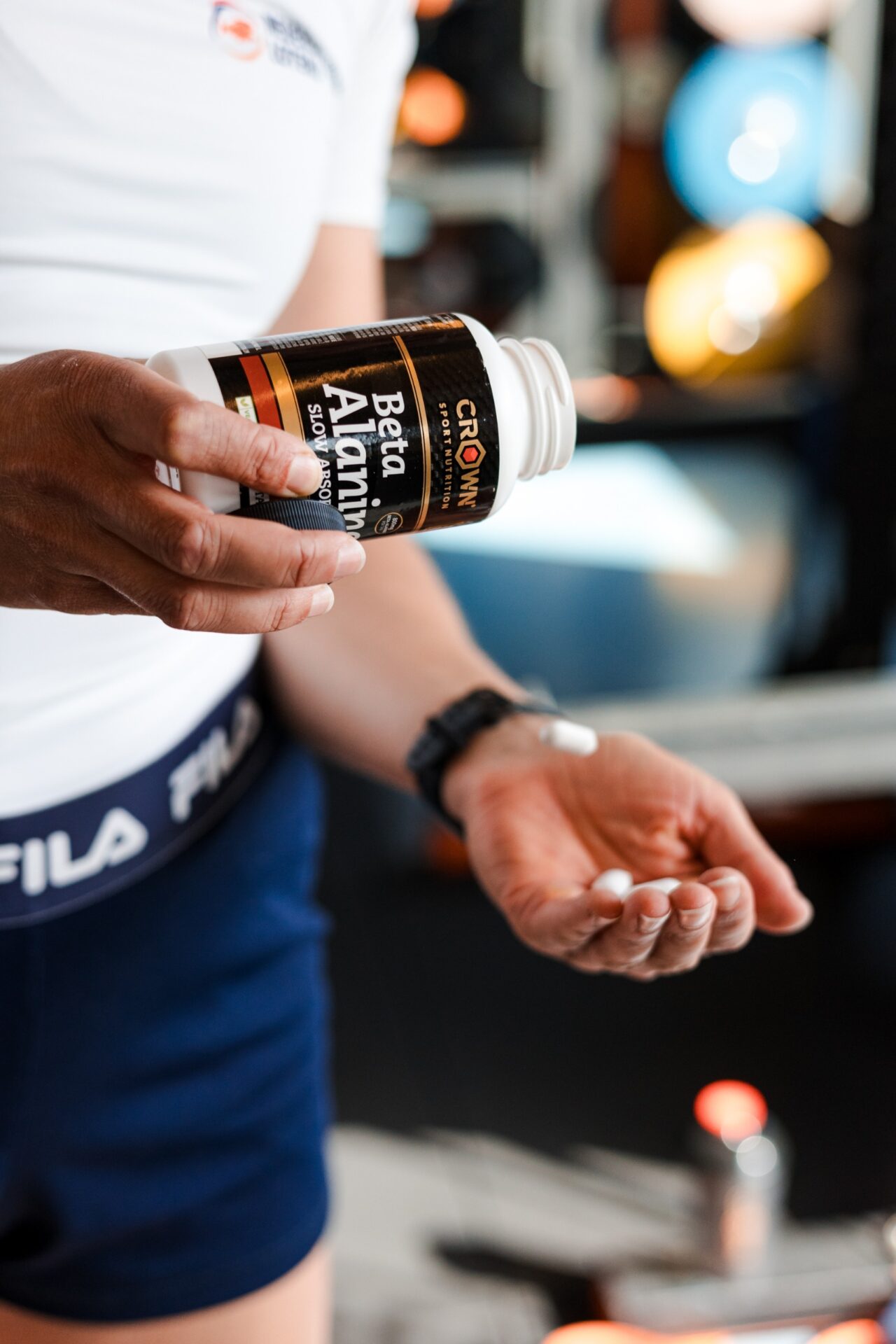
Beta Alanine Slow Absorption 120 tabs
Sports supplement providing 3,200 mg of slow-release beta-alanine per serving. Designed to optimise performance in both strength and endurance, delay fatigue and minimise the tingling sensation. Informed Sport certified, ensuring safety and effectiveness for both elite and amateur athletes. 120 tablets of 800 mg.
*Envío gratis en pedidos superiores a 25€
Scientific references
1. Saunders B, Elliott-Sale K, Artioli GG, Swinton PA, Dolan E, Roschel H, et al. β-Alanine supplementation to improve exercise capacity and performance: A systematic review and meta-Analysis. Br J Sports Med. 2017;51(8):658–69.
2. Stegen S, Bex T, Vervaet C, Vanhee L, Achten E, Derave W. β-Alanine dose for maintaining moderately elevated muscle carnosine levels. Med Sci Sports Exerc. 2014;46(7):1426–32.
3. Van Thienen R, Van Proeyen K, Eynde B Vanden, Puype J, Lefere T, Hespel P. β-Alanine improves sprint performance in endurance cycling. Med Sci Sports Exerc. 2009;41(4):898–903.
4. Avila-Gandia V, Torregrosa-Garcia A, Pérez-Piñero S, Ortolano R. One-Week High-Dose β -Alanine Loading Improves World Tour Cyclists’ Time-Trial Performance. Nutrients. 2021;13(8):2543.
5. Pérez-Piñero S, Ramos-Campo D, López-Román F, Torregrosa-Garcia A. Effect of high-dose β -Alanine supplementation on uphill cycling performance in World Tour cyclists : A randomised controlled trial. PLoS One. 2024;19(9):e0309404.
6. Perim P, Gobbi N, Duarte B, Oliveira LF De, Riani LA, Sale C, et al. Beta-alanine did not improve high-intensity performance throughout simulated road cycling. Eur J Sport Sci. 2022;22(8):1240–9.
7. Santana JO, de Freitas MC, dos Santos DM, Rossi FE, Lira FS, Rosa-Neto JC, et al. Beta-Alanine Supplementation Improved 10-km Running Time Trial in Physically Active Adults. Front Physiol [Internet]. 2018;9(August):1–6. Available from: https://www.frontiersin.org/article/10.3389/fphys.2018.01105/full